Accelerating the discovery of new sensor materials is the goal of AI-QUEST, a project that combines experimental materials research with artificial intelligence. A joint team from the Technical University of Munich, Leipzig University Hospital and IOM has successfully participated in a SPRIND Funke initiative with this project.
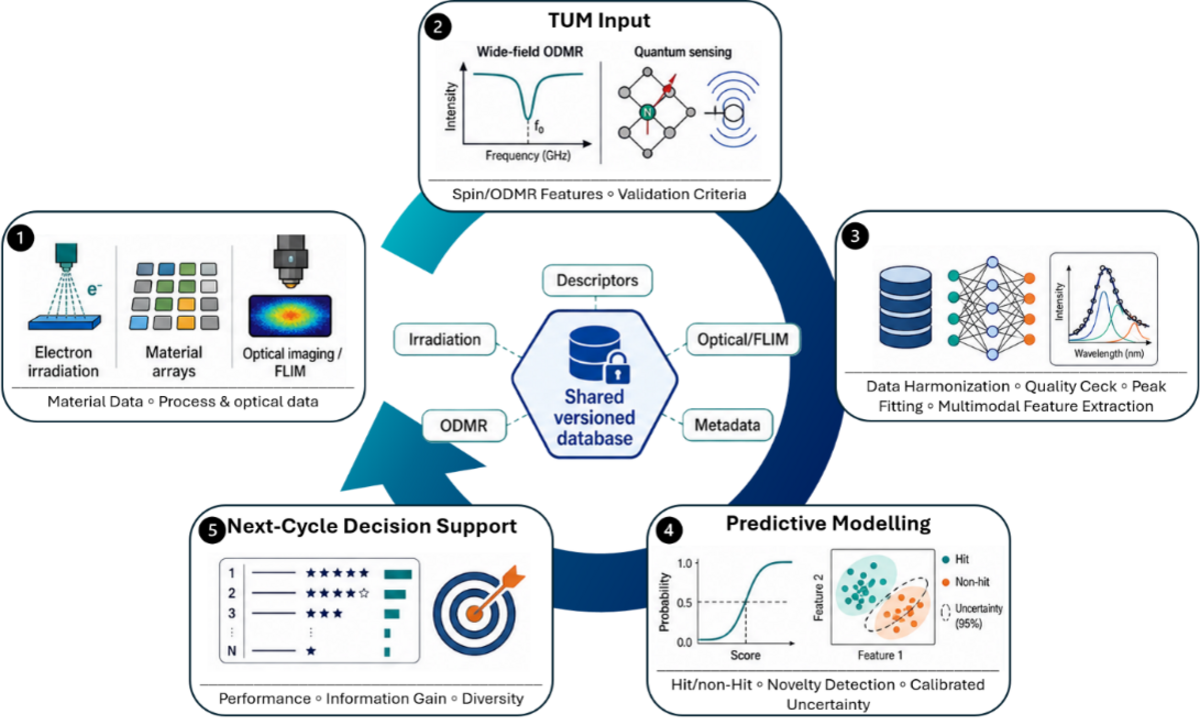
Which materials are particularly well suited to quantum sensing? To identify promising candidates more quickly, the team combines high-throughput irradiation tests at a particle accelerator with newly developed sample chambers. These enable numerous samples to be processed in parallel.
Following irradiation, the materials’ quantum properties are investigated through spectromicroscopic analyses. The team uses fluorescence microscopy and large-area spin imaging, combining optically detected magnetic resonance (ODMR) and T1 mapping to characterise the materials.
The resulting data provide the basis for the next step: the data science team combines the experimental results with information from materials science databases to train AI-based predictive models. These models are designed to recognise patterns and predict promising material candidates.
The predictions then inform the selection of materials for the next irradiation round, creating a cycle of experimentation, data analysis and targeted material selection. With this approach, AI-QUEST aims to accelerate the discovery of suitable materials for future quantum sensors.