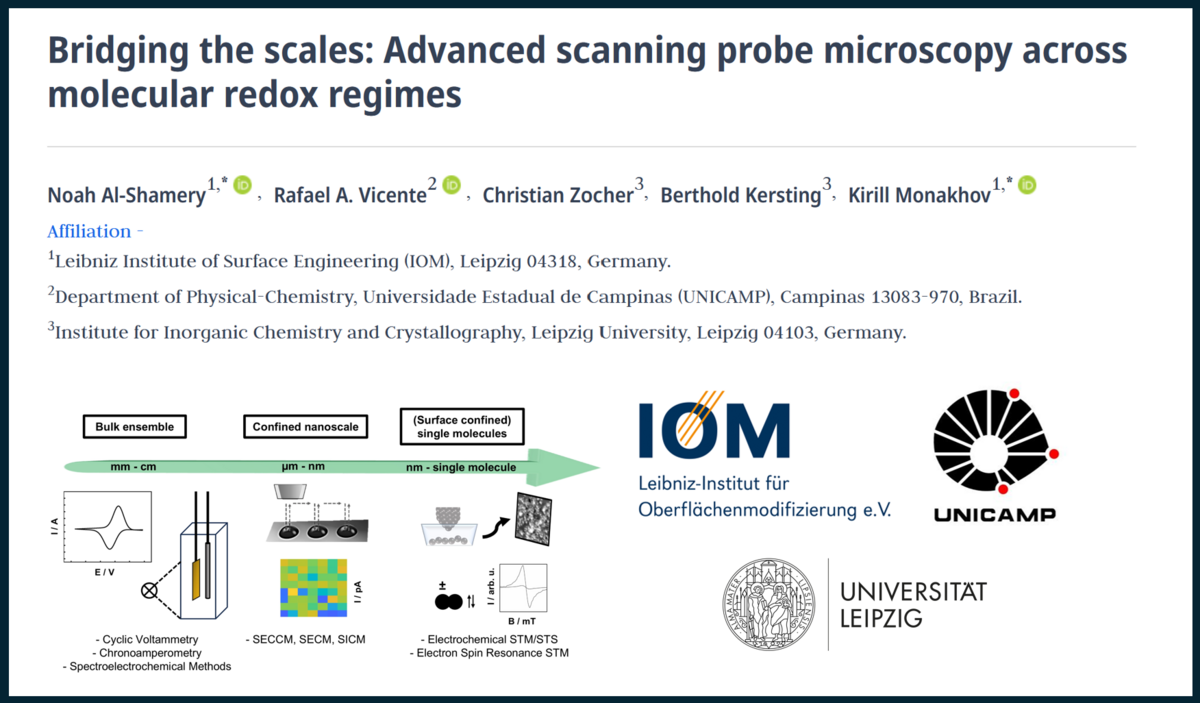
How can the electrical and magnetic properties of molecules be studied across different length scales, from large molecular ensembles down to individual molecules? A new mini-review published in the international open-access journal Smart Materials and Devices addresses this question.
The publication, “Bridging the scales: Advanced scanning probe microscopy across molecular redox regimes", is the result of a collaboration between the IOM, the University of Campinas (UNICAMP, Brazil), and Leipzig University.
The authors discuss how electrochemical techniques, scanning probe microscopy, and advanced nanospectroscopy can complement one another to better understand the behavior of redox-active molecules across different length scales. These approaches are particularly relevant for future applications in molecular electronics, information storage, and smart materials.
The work is connected to the scientific activities of the DFG-funded Collaborative Research Centre/Transregio 386 HYP*MOL (“Hyperpolarization in Molecular Systems”), involving the Leipzig collaborators Berthold Kersting and Christian Zocher. At the same time, the collaboration with Rafael A. Vicente highlights international research connections that are also fostered through the joint involvement of Al-Shamery and Vicente in the M-ERA.NET project CARBONEX-S.
The article was published on 12 October 2026 as part of the Special Issue “Intelligent Soft and Organic Matter: Fundamentals, Electrochemistry, and Sensing” in Smart Materials and Devices, for which Noah Al-Shamery serves as a Guest Editor.
Publication: Al-Shamery, N.; Vicente, R. A.; Zocher, C.; Kersting, B.; Monakhov, K.
Bridging the scales: Advanced scanning probe microscopy across molecular redox regimes
Smart Materials and Devices (2026). DOI: 10.70401/smd.2026.0054
Open access: https://www.sciexplor.com/smd/articles/smd.2026.0054