
Researchers from the Leibniz Institute of Surface Engineering (IOM) have presented recent work on redox-active functional materials, neuromorphic systems, and sustainable energy storage at two scientific events. Dr. Noah Al-Shamery and Eric Vogelsberg from Dr. Kirill Monakhov’s research group “Switchable Molecularly Functionalized Surfaces” attended the Workshop on Neuromorphic Organic Devices (NOD26) in Bad Schandau, Germany. Al-Shamery also presented his research at the 43rd Topical Meeting of the International Society of Electrochemistry (ISE) in Gdańsk, Poland, where he further strengthened international collaboration within the CARBONEX-S project.
Neuromorphic materials at NOD26 in Bad Schandau
The Workshop on Neuromorphic Organic Devices brought together researchers developing novel materials and devices for information-processing systems inspired by biological neural networks.
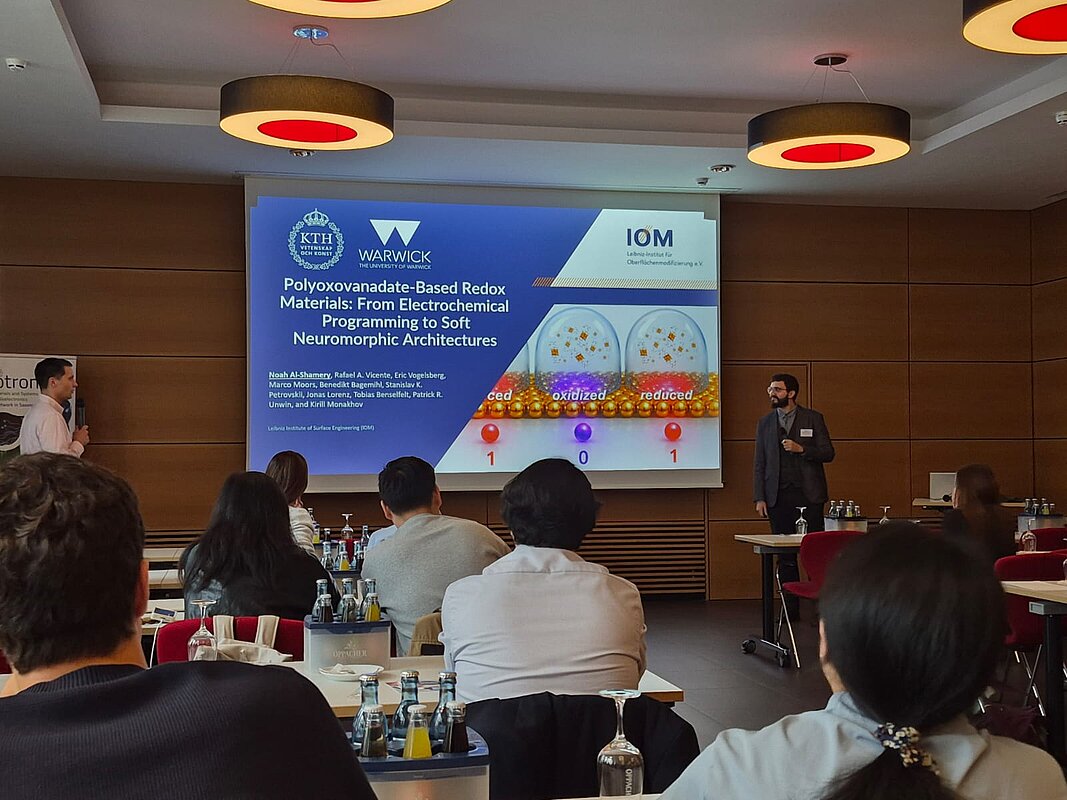
In his presentation, “Polyoxovanadate-Based Redox Materials: From Electrochemical Programming to Soft Neuromorphic Architectures”, Al-Shamery introduced research on the controlled electrochemical programming of molecular redox states. Using scanning electrochemical cell microscopy (SECCM), local electrochemical writing and reading processes can be investigated on surfaces. Building on these approaches, future work will explore hydrated nanocellulose-polyoxovanadate materials as potential platforms for soft neuromorphic systems. This research forms part of his independent A-SPM (Advanced Scanning Probe Microscopy) research direction, funded by the German Research Foundation (DFG).
Eric Vogelsberg contributed the poster “Improved Biological Sensing with Polyoxovanadate Organic Hybrids”, highlighting organic–inorganic polyoxovanadate hybrids and their potential applications in biological sensing.
The workshop provided both IOM researchers with an opportunity to discuss their work with the neuromorphic materials and devices community, exchange ideas, and establish new scientific connections.
Sustainable energy storage and CARBONEX-S at the ISE meeting in Gdańsk
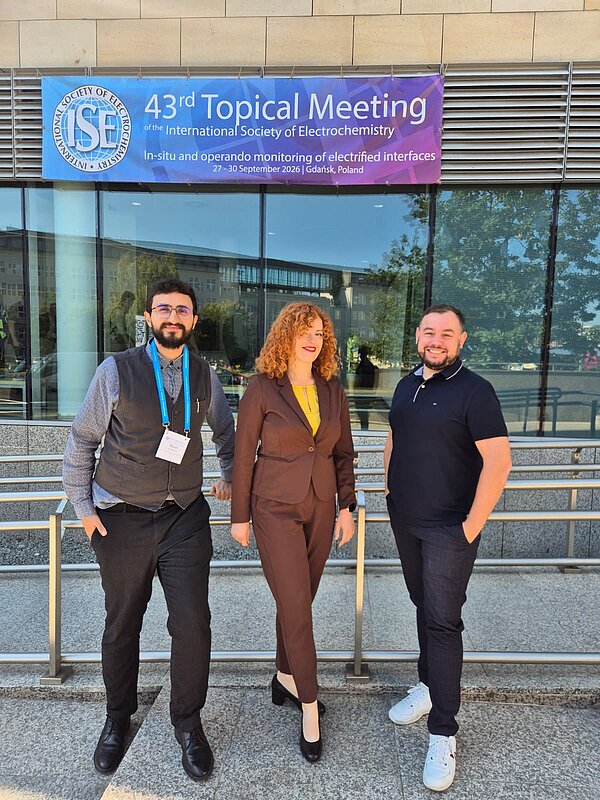
At the 43rd Topical Meeting of the International Society of Electrochemistry in Gdańsk, Al-Shamery presented “Polyoxovanadate-Nanocellulose Hydrogels as Sustainable Redox-Active Architectures for Aqueous Electrochemical Energy and Information Storage”. The talk focused on polyoxovanadate–nanocellulose hydrogels as sustainable redox-active material platforms for electrochemical energy and information storage in aqueous environments.
The visit to Gdańsk also provided an opportunity to advance collaboration within the international CARBONEX-S project (“Sustainable Nanocellulose-Carbon Hybrid Electrodes for Advanced Flexible Supercapacitors”). Associated with the M-ERA.NET Call 2025, the project aims to develop sustainable and flexible supercapacitors based on nanocellulose and carbon-based electrode materials. IOM contributes its expertise in nanoscale electrochemical characterization using SECCM and life-cycle assessment (LCA).
During a visit to Gdańsk University of Technology, Al-Shamery met with project coordinator Dr. Anna Dettlaff and Dr. Paweł Jakóbczyk. An important part of the meeting was the exchange of material samples between the partner institutions. Carbon samples from IOM were brought to Gdańsk for further investigation, while carbon nanowall powders and pyrolyzed straw produced at Gdańsk Tech were handed over for further research and LCA activities at IOM.
Together, the two events demonstrate how IOM research on molecular and hybrid functional materials connects different application areas, ranging from neuromorphic systems and biological sensing to sustainable electrochemical energy storage. Scientific exchange and collaboration within the CARBONEX-S consortium also contribute to strengthening the institute’s international research network.