
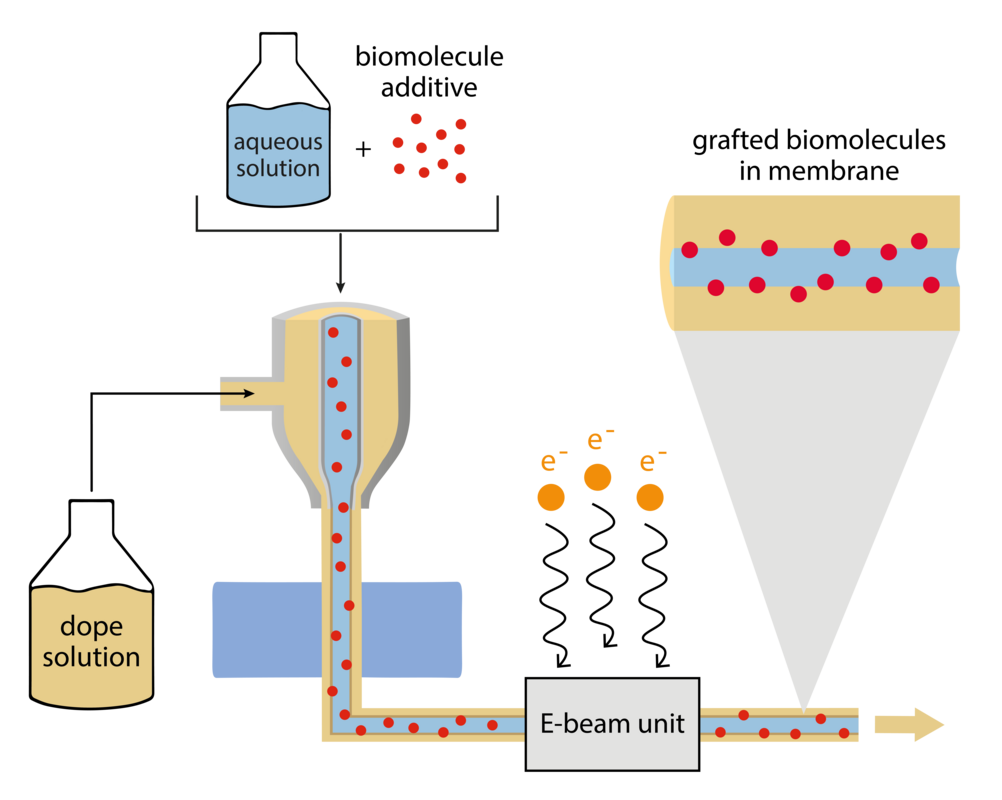
An research team of the IOM field of research "Surfaces of Pouros Memrane Filters" has developed an innovative approach that integrates protein immobilization directly into membrane preparation. The method uses an electron beam-assisted in-line process to covalently bind biomolecules — without harmful coupling reagents or complex multi-step post-treatment.
By introducing proteins into the bore liquid during the spinning process and applying electron beam irradiation, membrane formation and functionalization were achieved in a single step. Importantly, the membranes retained their sponge-like structure, mechanical stability and ultrafiltration performance.
A key finding of the study: immobilization is strongly influenced by protein–polymer interactions as well as size exclusion effects. While bovine serum albumin BSA was locally immobilized at the lumen side, lysozyme achieved loadings of up to 178 mg/m² at 300 kGy due to favorable electrostatic interactions between the polymer and protein.
This scalable and more environmentally friendly one-step process can be applied to a broad range of membrane systems. It opens up new opportunities for biofunctionalized hollow fiber membranes — including applications in biocatalysis, antifouling and biomedicine.
The results were published in the journal Separation and Purification Technology:
Konrad H. Leopold, Martin Schmidt, Daniel Breite, Astrid Kupferer, Marco Went, Andrea Prager, Erin D. Mongen, Dirk Enke, Agnes Schulze
Electron beam-assisted in-line protein immobilization during phase inversion of polyethersulfone hollow fiber membranes
Separation and Purification Technology 398 (2026) 2, 138110
https://doi.org/10.1016/j.seppur.2026.138110