
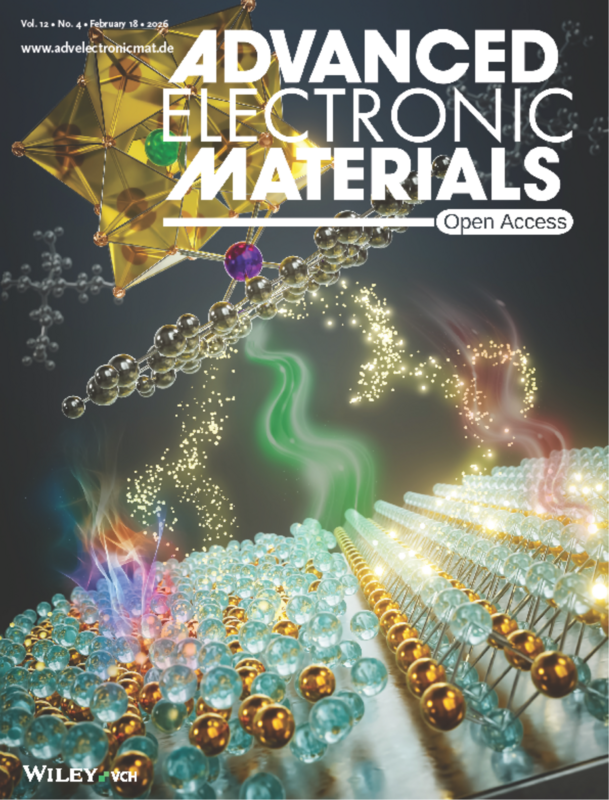
In a recent research study resulting from a close collaboration between the IOM, the Technische Universität Dresden, IFW Dresden, and Fraunhofer IMS in Duisburg, scientists led by Dr. Kirill Monakhov, Head of the IOM Research Group "Switchable Molecularly Functionalized Surfaces", present a significant breakthrough in the targeted control of 2D materials via molecular doping.
Writing in the journal Advanced Electronic Materials, the authors describe how the functionalization of atomically thin MoS2 layers with specific polyoxometalates (POMs) – specifically a lanthanide-phthalocyanine-augmented polyoxovanadate (V12-DyPc) – radically alters the optical and electronic properties of the semiconductor. Through precise control of the molecular coverage, the team succeeded in detecting the transition from excitons to negatively charged trions in photoluminescence, providing evidence of a systematic charge transfer between the molecule and the surface.
Dr. Monakhov sees these results as a confirmation of the potential of hybrid material systems: "By combining the chemical precision of functional molecules with the outstanding physical properties of 2D semiconductors, we create surfaces that do not just conduct passively but can actively process information. The fact that the multilevel switching behavior of our polyoxometalate molecules remains stable on both amorphous and polycrystalline MoS2 films opens up enormous possibilities for large-scale technological applications."
The article "Tunable Electronic and Optoelectronic Properties of MoS2 Through Molecular Coverage-Controlled Polyoxometalate Doping" is featured on the Front Cover of the current issue of Advanced Electronic Materials. This work underscores the leading role of the participating institutes in developing functional interfaces for the electronics of the future.
Reference:
J.-P. Glauber, M. Moors, D. A. Ryndyk, et al. Tunable Electronic and Optoelectronic Properties of MoS2 Through Molecular Coverage-Controlled Polyoxometalate Doping. Advanced Electronic Materials 12, no. 4 (2026): e00706. https://doi.org/10.1002/aelm.202500706