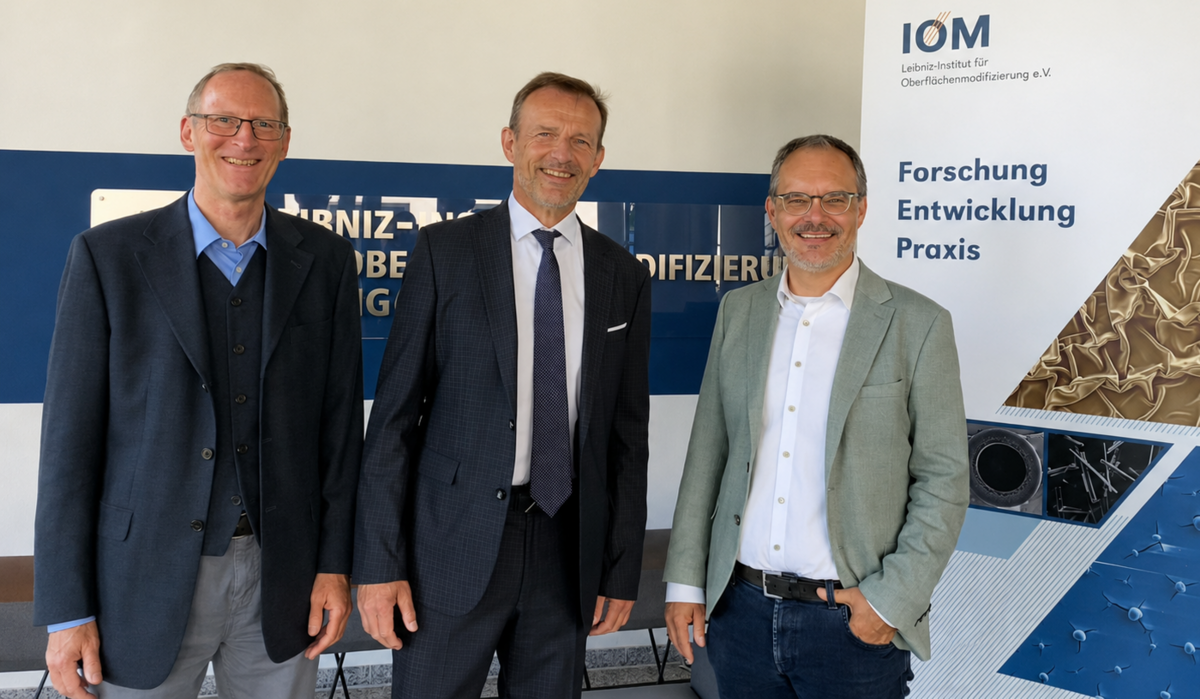
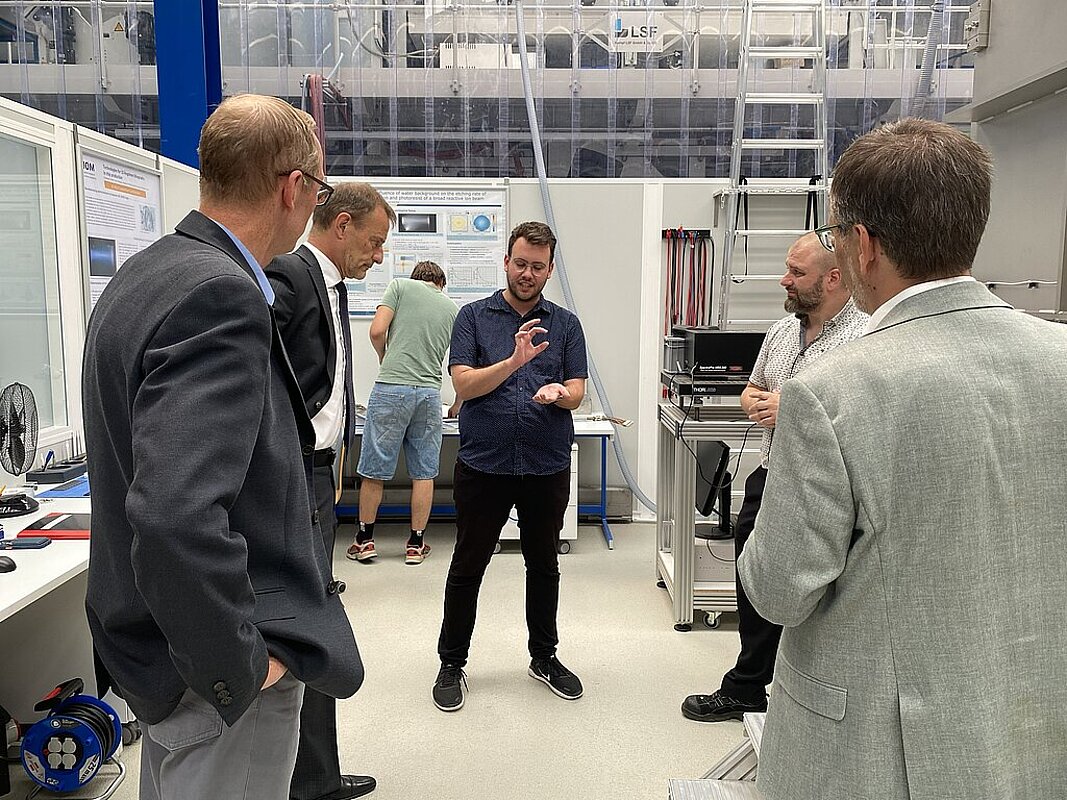
On July 28, 2026, Prof. Dr. Jörg Scheibe, Member of the State Parliament (MdL) and Third Vice President of the Saxon State Parliament, visited the Leibniz-IOM in Leipzig. After being welcomed by the Executive Board, the IOM’s Scientific Director, Prof. Dr. Benjamin Dietzek-Ivanšić, presented the institute’s main areas of research and its technological infrastructure. IOM researchers then used an ion beam source to illustrate the wide range of applications for ion beams - from high-precision surface processing to electric propulsion systems for space travel.
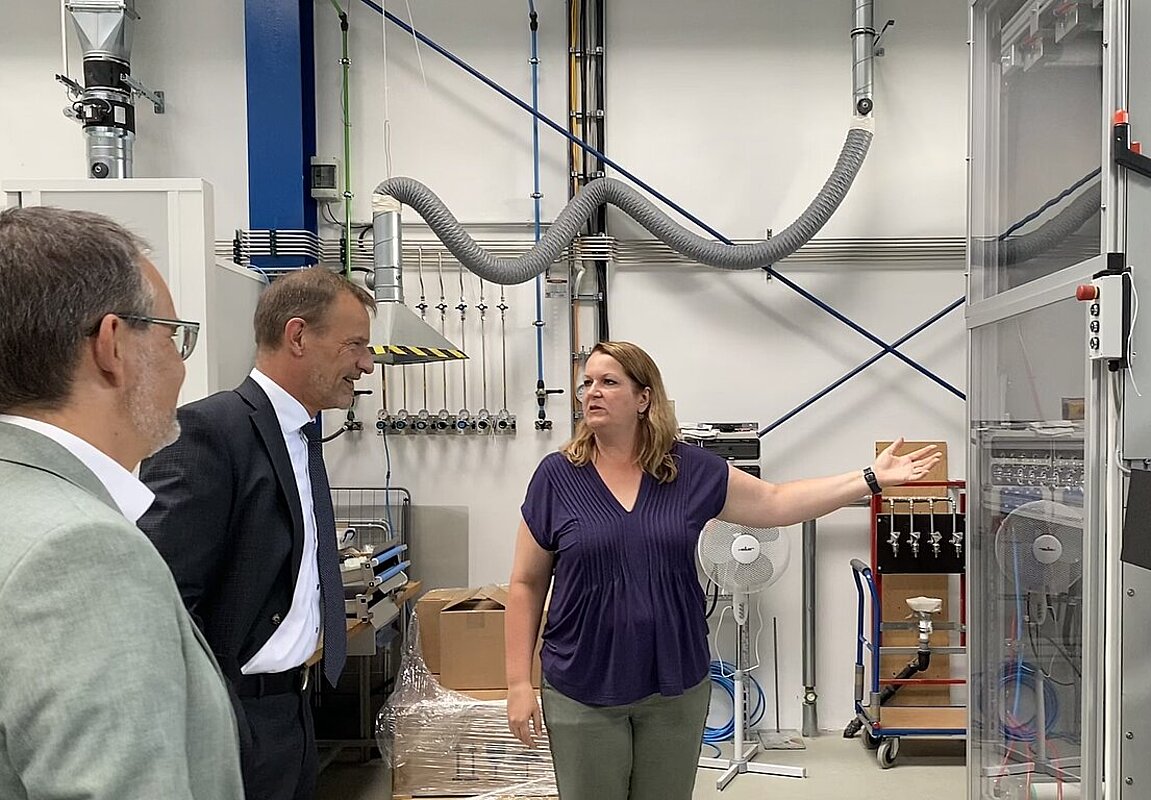
During the subsequent laboratory tour, it was demonstrated how basic research at the IOM leads to concrete solutions for societal and industrial challenges. One example of this is functionalized polymer membranes, which are selectively modified using electron beams. Such processes open up new possibilities for water treatment and the removal of pollutants. At the same time, it became clear how important it is to translate research results into practical applications, for example through collaborations with companies or spin-offs.
Another focus was on the processing of high-precision optics. Reactive ion beams can be used to structure or smooth surfaces with the highest precision. This requires a deep understanding of the underlying processes so that the methods can be reliably scaled up to larger areas and industrial scales.
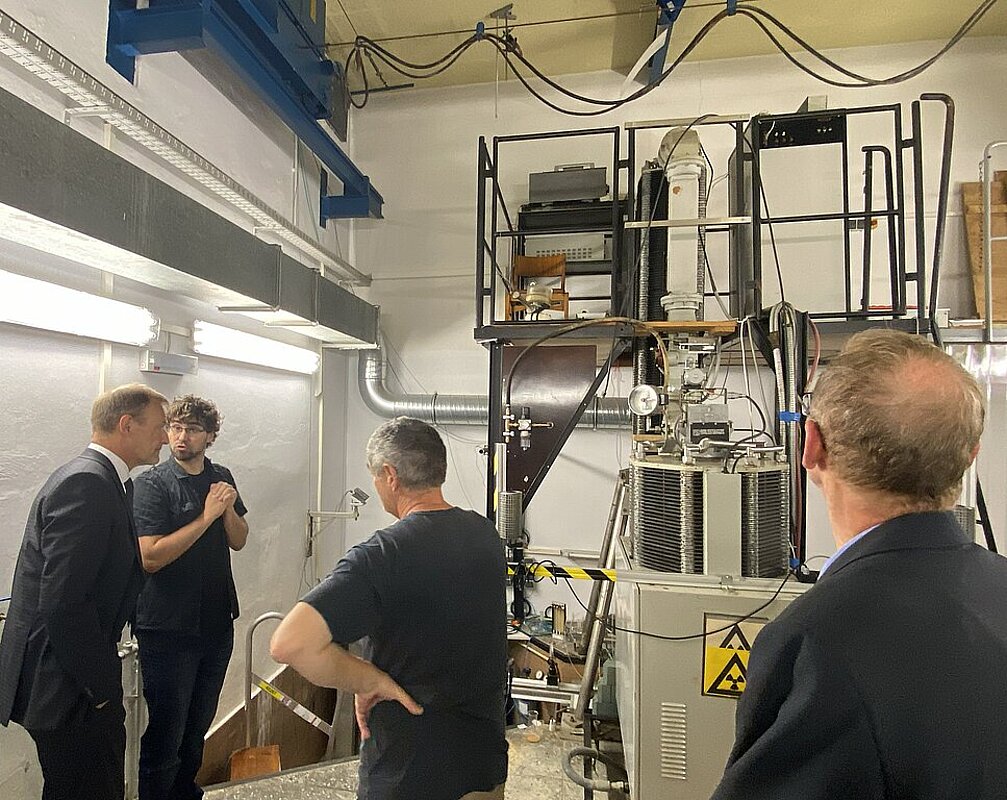
Finally, at the Hertz Electron Beam Laboratory, Prof. Dr. Scheibe gained insights into the IOM’s unique research infrastructure. The 10-MeV electron beam accelerators make it possible to examine materials under various conditions and modify them in a targeted manner. The combination of irradiation, processing, and analysis creates opportunities that are unique in Germany.
The visit provided an opportunity for an open exchange on the potential of modern surface and beam technologies for research, industry, and society. The IOM thanks Prof. Dr. Jörg Scheibe for his interest and the constructive dialogue.