
The performance of optical systems can be impaired by damage located beneath the surface, known as subsurface damage (SSD). This damage often results from mechanical processing steps. As part of the IGF project “tigeR - Multiscale crack characterization in optical manufacturing,” researchers from the Ultra-precision surfaces / Ion beam and plasma jet-based ultra-precision surface figuring research field investigated the depth of SSD in quartz glass surfaces using atmospheric plasma jet etching (PJE).
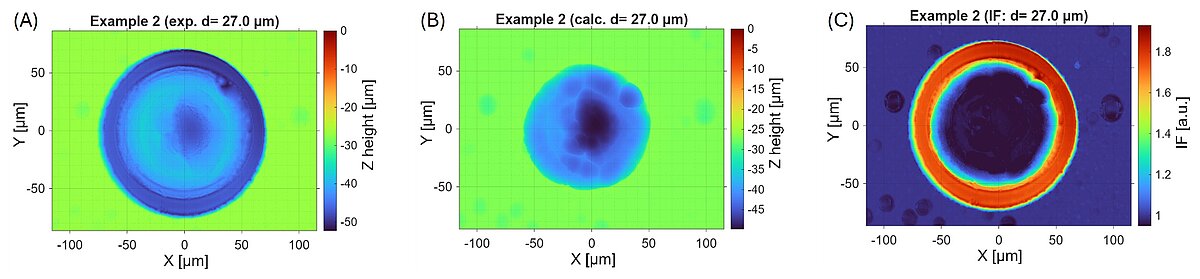
The focus of the recent publication “Modeling and experimental comparison of the plasma jet-induced etch front for subsurface damage determination” is a simplified mathematical model that describes the development of the etch front under the assumption of isotropic etching. After each etching step, the simulated surface is compared with the experimentally determined topography. The resulting isotropy factor (IF) reveals deviations from isotropic etching. Areas with an IF greater than 1 indicate anisotropic etching behavior and may thus point to the presence of SSD.
The researchers were able to show that the depth-dependent maximum of the IF correlates with the experimentally determined SSD depth. The method was validated using defined Vickers indentations, scratches, and conventionally fabricated samples.
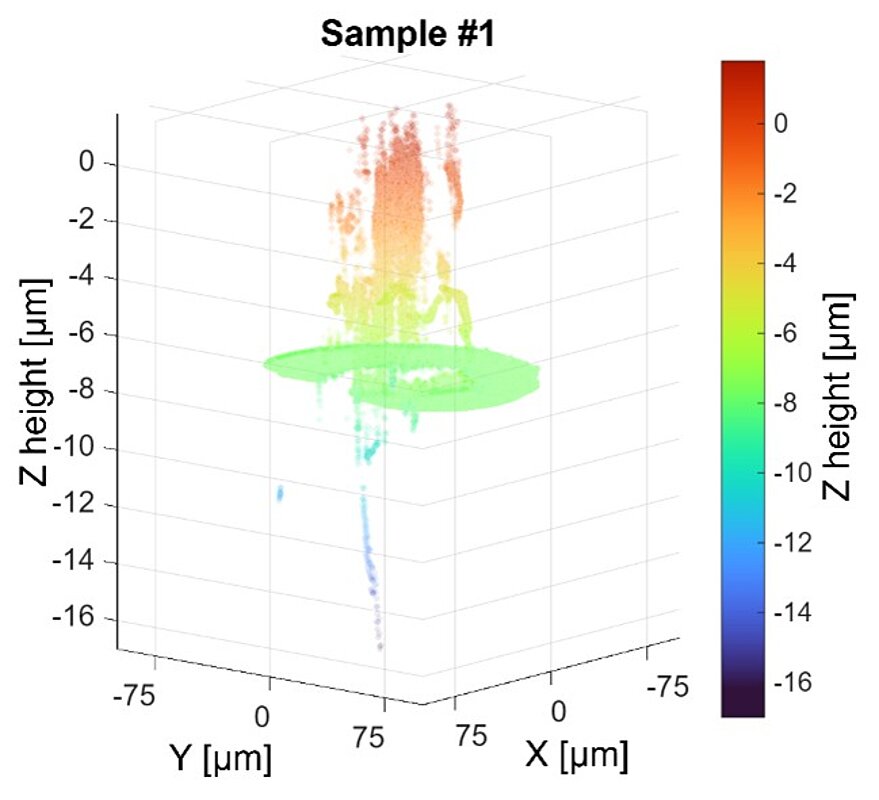
The developed approach not only enables the quantitative determination of the SSD depth but also the three-dimensional reconstruction of the crack morphology. The combination of computer-aided modeling and experimental investigation thus offers a robust method for characterizing the quality of optical components.
IGF Project No. 01IF22724N of the F.O.M. is funded by the Federal Ministry for Economic Affairs and Energy (BMWE) as part of the Program for the Promotion of Industrial Collaborative Research (IGF), based on a resolution of the German Bundestag.
Further information on the publication:
Modeling and experimental comparison of the plasma jet induced etch front for subsurface damage determination
H. Müller, T. Arnold
J. Eur. Opt. Society-Rapid Publ. Volume 22, Number 1, 2026
https://doi.org/10.1051/jeos/2026047