
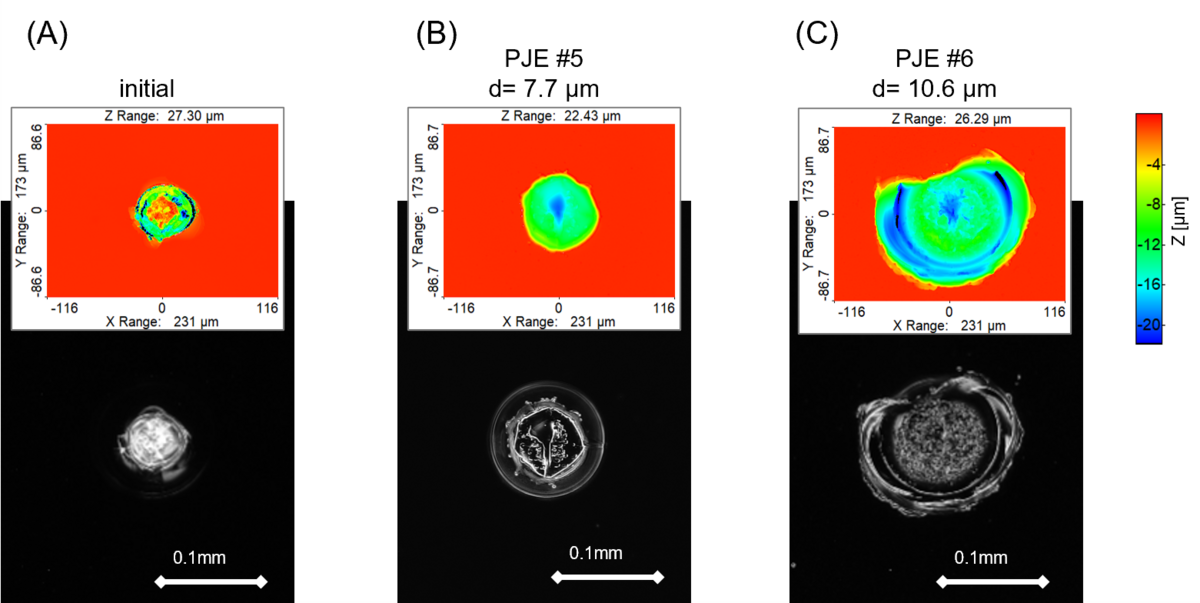
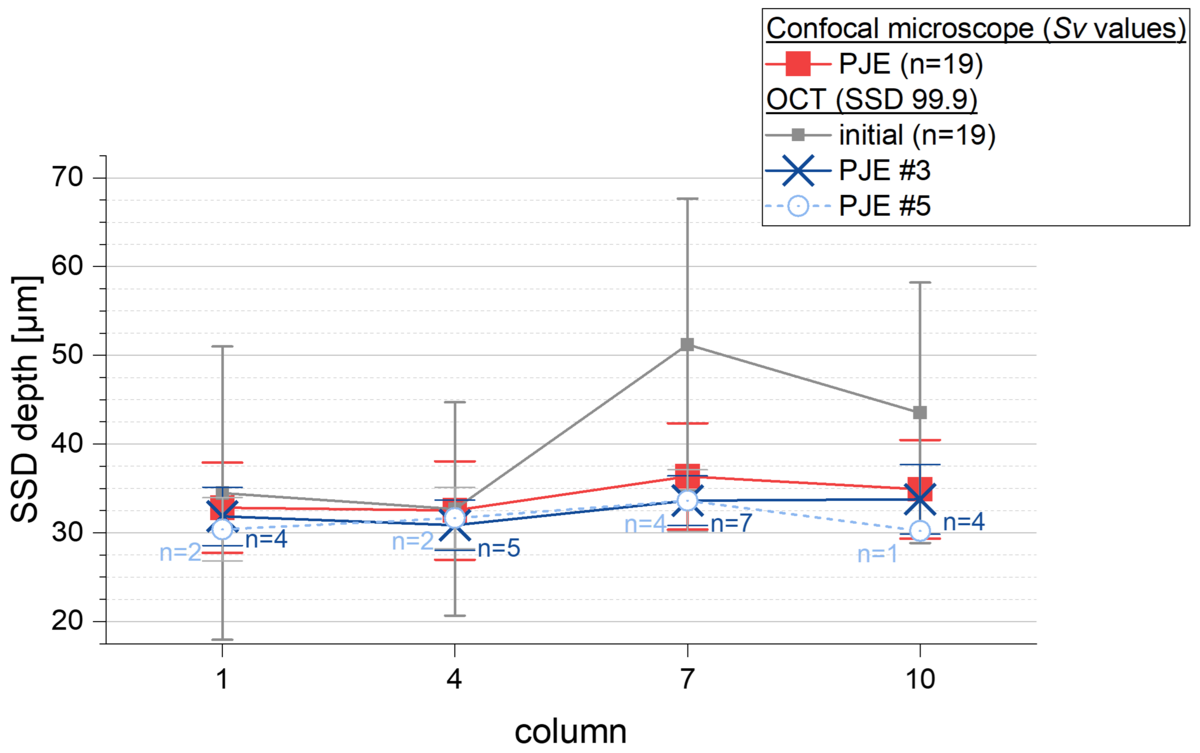
The manufacturing of precision optics faces a major challenge in the form of subsurface damage (SSD), as it can significantly impair the optical performance and lifetime of the components. In the research project “tigeR” (Multiscale Crack Characterization in Optics Manufacturing), the non-destructive measurement method of optical coherence tomography (OCT) was validated using results obtained after stepwise material removal. Here, the atmospheric plasma jet was applied being a more environmentally friendly alternative compared to conventional wet chemical etching.
Systematic investigations using SSD generated by a Vickers indenter are published in the current paper “Characterization of subsurface damage in fused silica using non-destructive optical coherence tomography and a destructive approach by iterative plasma jet etching.” The results of the OCT measurements carried out by our project partner at the University of Applied Sciences Jena were validated by researchers of the field of research “Ultra-precision Surfaces” at the IOM using a combination of plasma jet etching and white-light interferometer measurements.
The publication also presents a hybrid method combining plasma jet etching and OCT to measure the depth of subsurface cracks in fused silica more precisely than either technique alone. This combination enables reliable quantification of damage, thereby providing an important tool for quality control in the manufacture of high-quality optical components used in the fields of optics and photonics.
The IGF project No. 01IF22724N of the F.O.M. was funded by the Federal Ministry for Economic Affairs and Energy (BMWE) as part of the program for the promotion of industrial joint research (IGF) due to a decision of the German Bundestag.
Publication:
S. Frank, H. Müller, W. Zhang, D. Thelemann, T. Arnold, J. Bliedtner,
Characterization of subsurface damage in fused silica using non-destructive optical coherence tomography and a destructive approach by iterative plasma jet etching,
J. Eur. Opt. Society-Rapid Publ. 2026, 22, 21
https://doi.org/10.1051/jeos/2026015