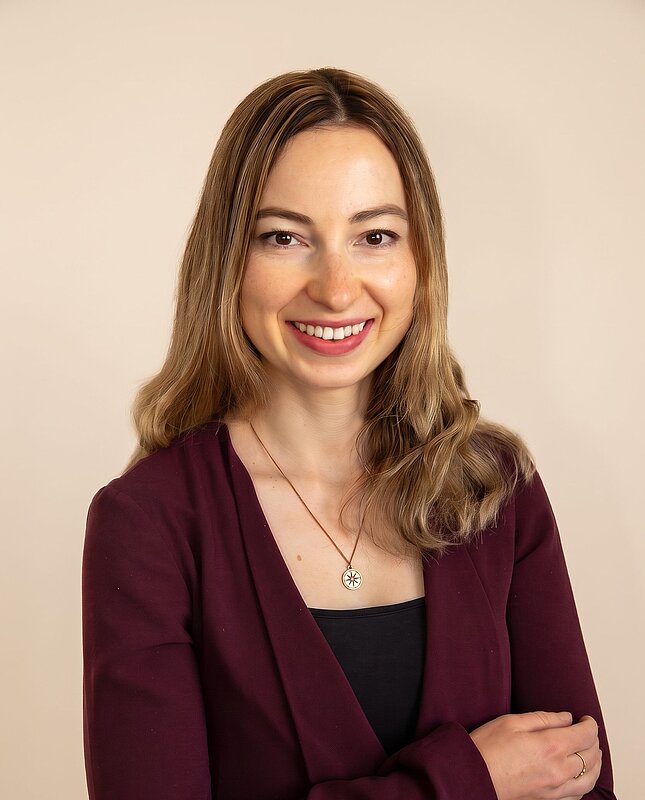
As of 1 October 2026, Prof. Julia Westermayr will take up the professorship in Digital Surface Engineering at Leipzig University. The professorship is linked to the leadership of the “Theory and Simulation” Department at the Leibniz Institute of Surface Engineering (IOM).
Westermayr conducts research at the interface of theoretical chemistry, simulation, and artificial intelligence. Her work focuses on developing AI models that learn from physically grounded data and enable predictions for previously unexplored molecules, materials, and surfaces. A particular focus is on light–matter interactions.
For Westermayr, Digital Surface Engineering means designing surfaces and materials in a targeted way on the computer. Their properties are to be predicted and optimized before the materials are experimentally produced. “The potential lies in making the vast number of possible surface modifications and material combinations systematically and predictably accessible,” Westermayr explains.
In her new role, she aims to integrate theory, simulation, and experiment even more closely at IOM. Planned activities include AI methods for excited states, transferable physical models, and automated simulation–experiment cycles in which models actively propose subsequent experiments. To support this approach, an automation laboratory will be established step by step. Using selected test reactions, the cycles of prediction, automated experimentation, and feedback of measurement data into the models will first be established and validated on a small scale. The aim is then to transfer these approaches to more complex research questions and larger material and parameter spaces.
Westermayr sees particular opportunities in the close connection between university-based and non-university research. While new methods can be developed at Leipzig University and early-career researchers can be trained, IOM provides a wide range of experimental capabilities based on ion-, electron-, plasma-, and photon-based processes.
“I am particularly looking forward to helping shape the department from the ground up and to launching the first joint projects with IOM’s experimental research groups. In the long term, I am looking forward to the moment when a molecule proposed by our models makes its way from the computer into the laboratory and is experimentally confirmed.”
We warmly welcome Prof. Julia Westermayr and her team to IOM and look forward to working with her and to the new scientific directions she will help shape at the institute.