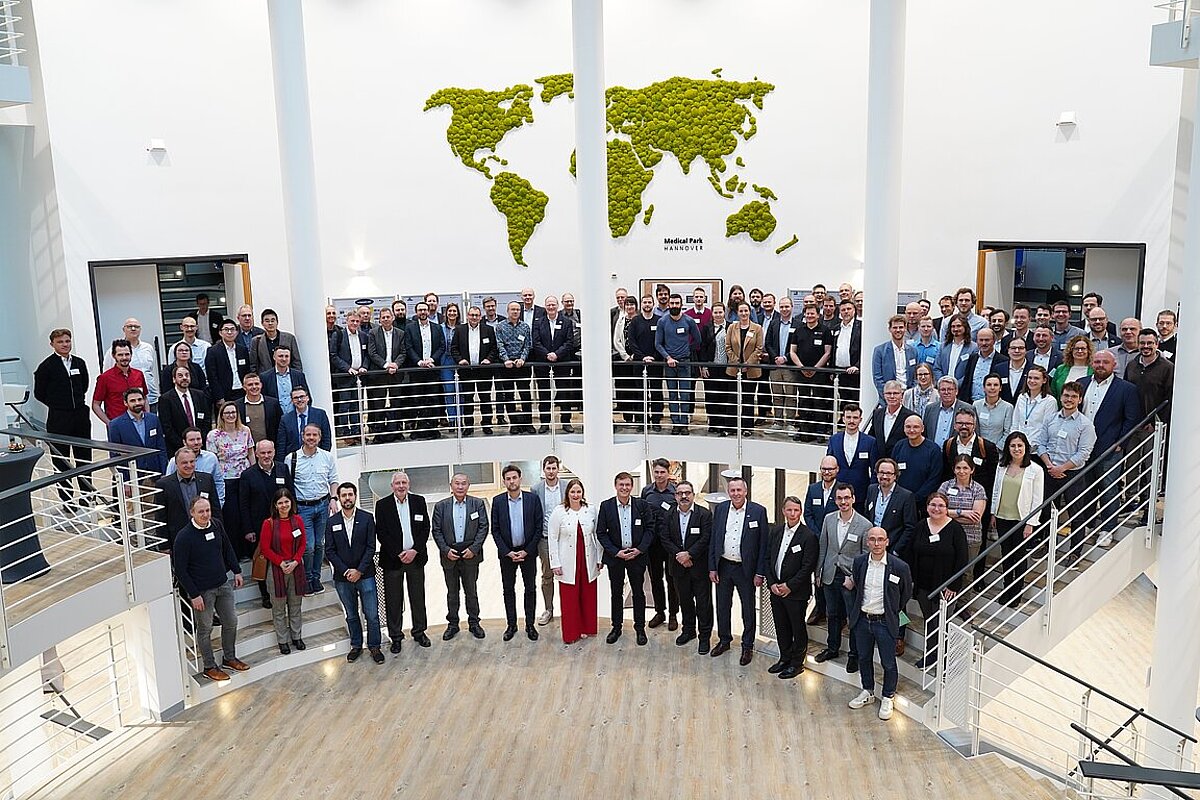
The first “Fusion” status meeting took place on March 10 and 11 at the Laser Zentrum Hannover (LZH). The event was jointly organized by the LZH and the project management agency VDI Technologiezentrum and funded by the BMFTR.
During the two-day networking meeting, the current progress of the ongoing collaborative projects from the funding initiative “Basic Technologies for Fusion – On the Way to a Fusion Power Plant” (Module A, Round 1) was presented. The projects presented cover the three central fusion hubs: magnetic fusion, inertial fusion, and the fuel cycle.
Dr. Gregor Dornberg, a scientific researcher in the IOM research field Ultra-Precision Surfaces/Ion Beam-Assisted Patterning and Smoothing, attended the event on behalf of the IOM-based project “NanoAR – Anti-reflective Metasurfaces on Materials with Large Bandgaps". He presented the project’s content via an accompanying poster and was available for technical discussions.
The "NanoAR" project addresses key challenges in laser inertial fusion. The goal is to develop highly durable, virtually reflection-free optical surfaces capable of withstanding extreme laser power. To this end, innovative nanostructured metamaterials are being researched that significantly reduce reflections while simultaneously increasing the resilience of optical materials with a wide bandgap, such as quartz glass. A particular focus is on the direct nanostructuring of a surface as an alternative to the traditional combination of a substrate material and multiple layers of material applied to it.
With this approach, NanoAR makes an important contribution to improving the efficiency and service life of high-performance optics in future fusion facilities. The Ultra-Precision Surfaces research area thus not only strengthens its expertise in the field of ion beam-assisted nano- and microstructuring of surfaces but, together with its participation in the SAXFUSION network, also contributes significantly to the further development of fusion research in Germany.