
The European Union generates 12.6 million tons of textile waste annually, of which only 22% is currently reused or recycled. To counteract this deficit, Amendment Directive 2018/851 to Waste Framework Directive 2008/98/EC stipulates that the separate collection of used textiles and their material recycling will be mandatory from January 1, 2025. The incineration or landfilling of used textiles, which has been common practice up to now, will therefore generally no longer be permitted.
A key prerequisite for achieving the desired circular textile economy is the sorting of used textiles into as few types as possible. This is already possible today for many materials commonly used in the textile industry, such as cotton, polyester, and polyamide. Classification is carried out – similar to the sorting of packaging waste (yellow bin or yellow bag) – using near-infrared (NIR) reflection spectroscopy or NIR hyperspectral imaging based on this.
However, these established methods reach their limits with certain groups of materials. In particular, black textiles, especially those dyed with carbon black, cannot yet be sorted reliably because they reflect little or nothing in the NIR range and therefore do not provide usable spectra for classification. Elastic textiles containing elastane pose another significant problem. Elastane interferes with numerous recycling processes. For example, it cannot be re-dyed after manufacture. This means that such textiles must be collected separately. Due to the special processing technology of elastane and its usually very low content—typically 1 to 3% in jeans—elastane cannot be reliably detected in the currently used automated sorting processes for used textiles and therefore cannot be reliably sorted out. Similar restrictions also apply to coated textiles.
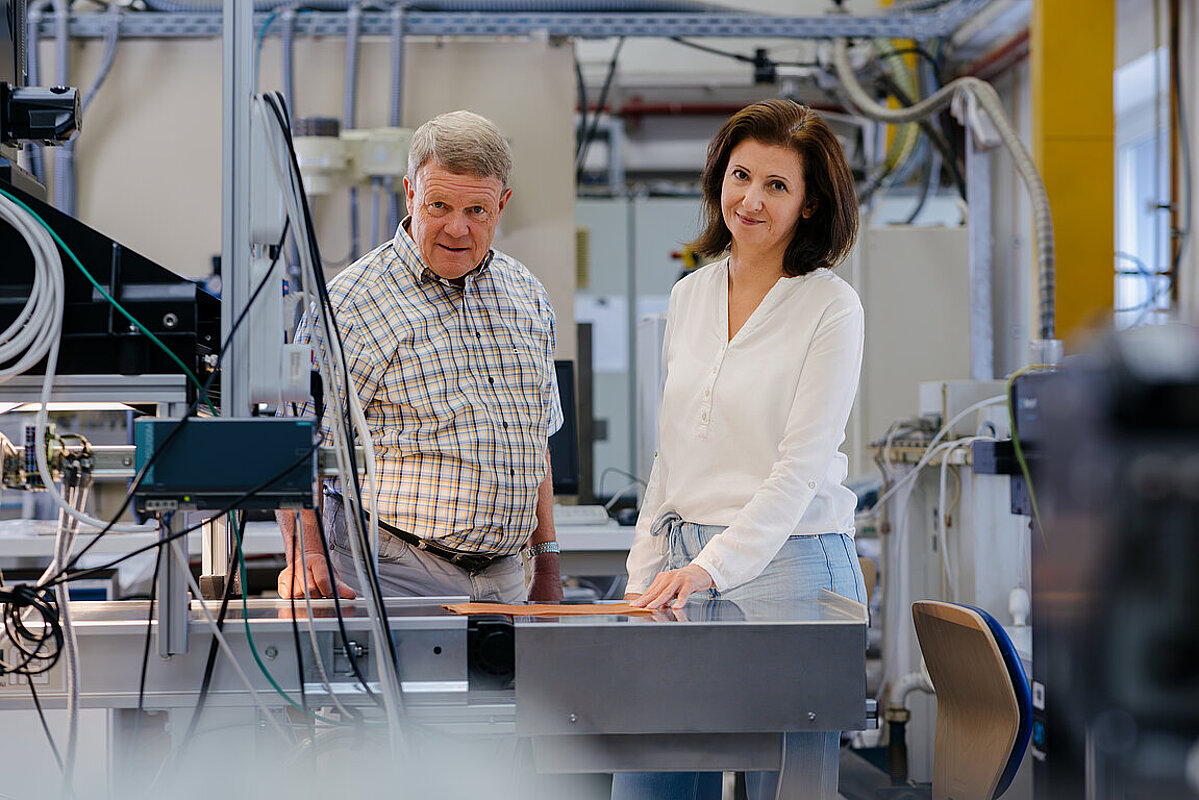
Against this backdrop, the Horizon Europe project (01181988) “Intelligent Textile SORTing for enable CIRCuLarity” (SORT4CIRC) was launched on December 1, 2025, with a budget of €5 million. Researchers from the IOM's cross-disciplinary unit “Material Characterization and Analytical Service” are participating in the project together with a total of 14 partners from eight European countries. The aim of the project is to develop more powerful analytical approaches and technologies that enable the identification and sorting of materials that cannot be detected, or can only be detected inadequately, using the methods currently in use.
In addition to innovative analytical techniques that have not yet been used in the sorting of plastic and textile waste, artificial intelligence (AI) methods will also be employed. These are expected to have the potential to reliably detect even components with very low proportions, such as elastane.
At the end of the three-year project, a demonstration plant equipped with various analytical techniques is to be set up. This plant will be capable of fully automatically sorting textiles from a wide range of possible material compositions, regardless of their color or any interfering components they may contain. In this way, materials that are sorted by type can be efficiently recycled and, in the best case, made available again for the production of new textiles.
Contact at the IOM:
Dr. Tom Scherzer
Research scientist / Material Characterization and Analytical Service
Phone: (+49) 341-235-3184
E-Mail: tom.scherzer@iom-leipzig.de